Monetize your inventory with
high-performing commerce demand.
Publisher monetization powered by a supply side platform built for e-commerce. Quick to set up, straightforward to scale, and fully incremental to your existing stack.







Everything you need to add commerce media to your publisher monetization mix
Commerce inventory outperforms other channels because the demand behind it is performance-focused. You get paid per click, with fill rates that leave fewer impressions on the table.

Higher CPM
Commerce-intent placements attract stronger bids than standard display.

High fill rate
A large, active demand pool consistently keeps your inventory filled.

CPC model
You earn for every click. No guesswork — what you see in the dashboard is what you get paid.
CMT's demand pool is built around e-commerce: retailers, direct-to-consumer brands, and online shops with active CPC budgets, not repurposed generic display spend.

Commerce-specific demand
Our advertisers are running performance campaigns with real conversion goals, not brand awareness spend.

Deep demand pool
From retail and fashion to electronics and travel — a diverse advertiser base, all competing for your supply.

Demand visibility
See which advertiser categories are matched to your placements. Know what's running on your inventory and why.
A publisher panel that shows you what's actually happening (revenue, fill rates, campaign activity) without aggregating your audience data or obscuring how earnings are calculated.

Transparent reporting
Live revenue figures, CPC rates, fill rates, and placement performance all in one place.

Built to integrate
Connect CMT to your existing reporting stack or programmatic setup. Built for publishers who want to integrate, not just install.

First-party data stays yours
Contextual targeting works from your content signals. Your audience data isn’t fed into a shared pool, and no 3rd-party cookies are required.
No drawn-out onboarding, no third-party cookie dependency, no dedicated dev sprint required. Add CMT to your existing setup and start earning — then scale at your own pace.

Cookieless-ready
Contextual targeting doesn't rely on third-party cookies. Your monetization keeps working as the industry moves away from them.

Fast setup
A JS tag, a domain verification, and you're in. Most publishers go from registration to revenue seamlessly.

Real support
Onboarding help and a team you can actually reach. You can count on our expert support.

Get the right commerce demand for your media through CMT ad monetization platform
Content sites

Apps & Extensions

BNPL & FinTech

Comparison sites

Email & Newsletters

Editorial & News

Register and start earning in three steps
No lengthy onboarding, no sales call required. Connect your inventory and you're in the demand pool. Earning starts when the first click lands.

Build an owned, private-labelled monetization layer with CMT
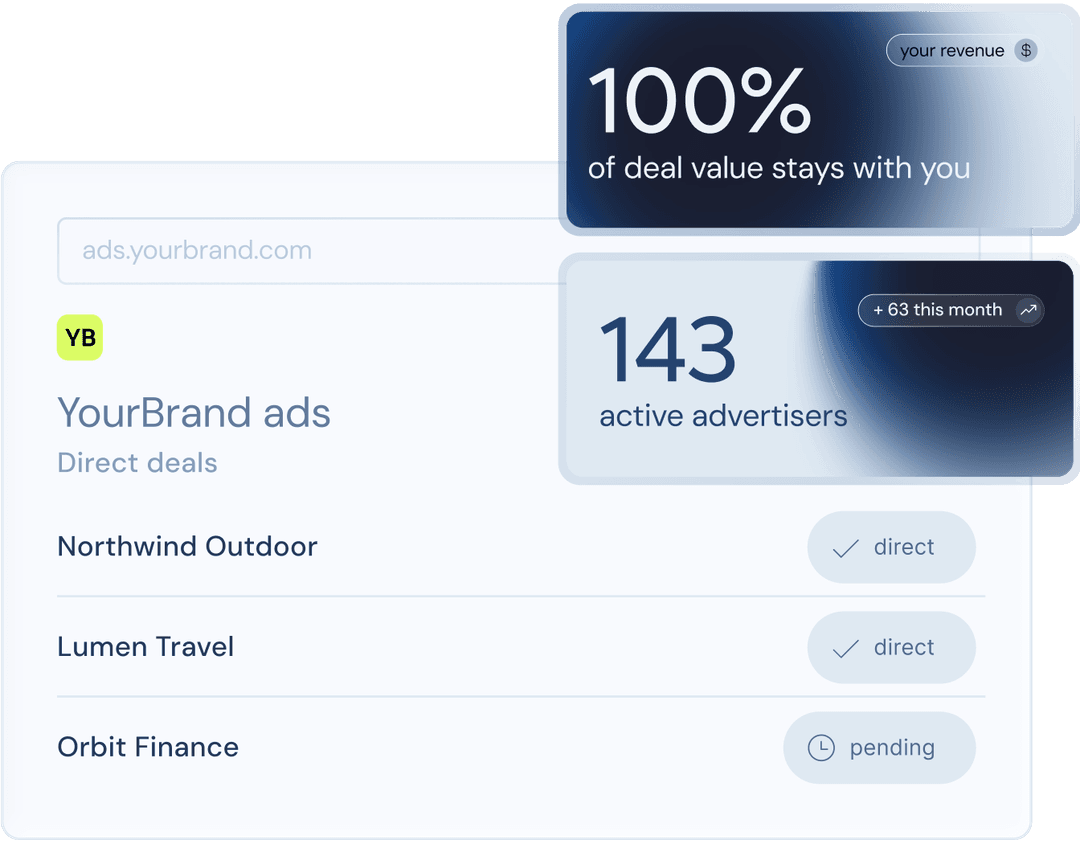
If you'd rather build than join, CMT can power a fully custom monetization tool — your brand, your domain, your direct deals with advertisers. We run the infrastructure, while you own the channel.
Traffic is one inventory. Transactional data is another.
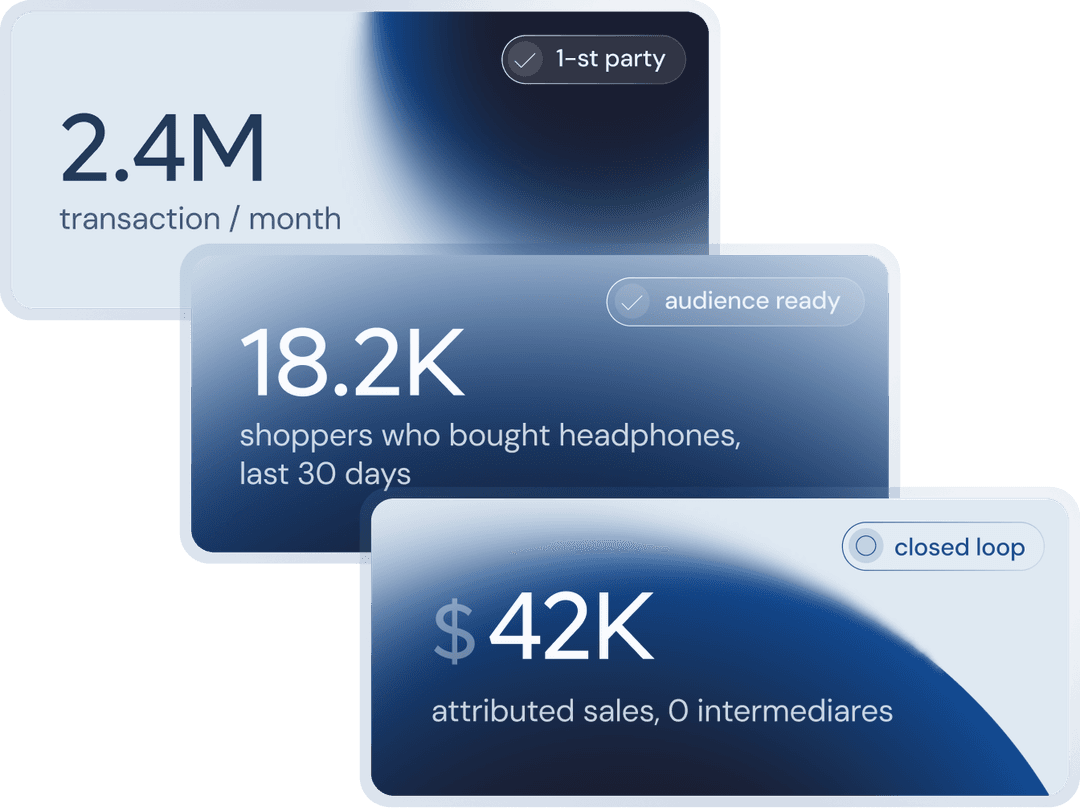
ClearLoop lets you monetize not only traffic, but also the first-party data you sit on. Learn how to turn it into additional revenue stream.
Your inventory.
More revenue from it.
Register, integrate, and start earning from commerce media demand — incremental to everything you're already running.


Frequently Asked Questions
Joining the SSP connects you to our demand coming from a broad network of advertisers competing for clicks. Plug in and earn per click with no extra workload on your side. CMT Direct is for publishers who want to go further: build an own branded, private labelled product, based by premium advertiser relationships, and custom revenue models built on our infrastructure.
CMT works with a broad range of media types, including (but not limited to) content sites, comparison sites, apps and browser extensions, email interface publishers, editorial and news outlets, and BNPL platforms. What they share is commerce-relevant context: audiences that are researching, comparing, or actively making purchase decisions. CMT also partners with premium media publishers, building custom and private monetization solutions for retailers, data owners and publishers.
CMT supports commerce-specific placements of brand homepage, product or deeplinks. Formats are native to publisher context and UI and matched to purchase-intent demand. Commerce media is designed to blend with publisher environments rather than disrupt the reading or browsing experience. A full breakdown of formats, placement specs, and integration options is available on the formats page.
Our open-web ad exchange supports two integration paths. You can either use CMT as your only demand source, connecting your inventory via XML or JSON. You can also plug CMT demand into an RTB real-time auction system alongside other demand provides.
CMT Direct monetization and retail media publishers integration is always custom and best-fitted to publishers' tech stack and preference.
CMT runs automated invalid traffic detection and publisher-level quality scoring. Your inventory is verified before entering the demand pool. This protects your standing in the network and ensures advertiser confidence in your placements, keeping bid competition healthy and your earnings stable. We monitor and filter our supply 24/7.
There's no hard minimum, hence the scalability of our solution.That said, any commerce media platform works best when there's enough inventory volume for demand matching to run consistently. If you're in early growth, you can still integrate and start seeing how demand maps to your placements; earnings will increase as your traffic does. Publishers at all stages use CMT as an incremental revenue layer alongside existing monetization.
With CPC (cost per click), you earn every time a user clicks an ad served on your inventory. CPM (cost per mille) describes a rate per thousand clicks, regardless of whether a sale happens or not. CPC directly ties your earnings to how well the demand performs on your placements. In practice, because commerce-intent inventory converts well for advertisers, it attracts stronger bids, and your effective CPC reflects that competition. It's more transparent than averaged CPM estimates, and you can track it click by click in your dashboard.
CMT Direct monetization and retail media publishers access custom tracking and revenue models based on their preferences.
RTB (real-time bidding) is the auction mechanism that runs every time one of your pages loads. In milliseconds, advertisers on the demand-side platform (DSP) submit bids for your placement, and the winning bid serves the ad. As a publisher, what RTB means practically is that your inventory is continuously price-discovered: more competition for a placement drives the bid price up, which increases your earnings. CMT's SSP (supply side platform) handles this on your behalf, connecting your inventory to the ad exchange where bids are settled.
No, and that's by design. CMT is incremental monetization, not a replacement. It layers on top of whatever you're already running. You control which placements CMT fills; everything else in your existing stack continues as normal. Our publishers work with other display advertising platforms or ad networks. The difference is CMT independence. Our demand sits outside Amazon, Google, and Meta's closed ecosystems — so the revenue it generates is genuinely additional.
Website monetization typically starts with display advertising — joining an ad network or display advertising platform to fill your inventory with paid placements. From there, publishers layer in additional revenue streams based on their audience and content type: affiliate links, sponsored content, or commerce media. CMT sits in the second category, as we deliver a CPC-based publisher monetization.
A supply-side platform (SSP) is the technology publishers use to manage their advertising inventory and make it available to advertisers through programmatic auctions. When a user loads your page, the SSP sends your placement into a real-time bidding auction. Advertisers on the demand side compete for it, and the winning bid serves the ad. CMT operates as an SSP for commerce media specifically, connecting publisher inventory to a pool of e-commerce advertisers.